
The first time I walked into the valley of Angel Eye Mountain, it felt almost unreal. Jagged limestone peaks rose like broken teeth, and in the middle stood the mountain with its perfect round arch—the “eye” that seemed to watch over everything below.
If I had only stopped to take a photo, I know I would have missed its best part. For many locals, camping here is the highlight of the Cao Bang Loop, sometimes even the main reason they come to this province.
I almost skipped it myself. If you’ve read my Cao Bang Loop guide (and if not, you can find every detail there), you already know I was traveling in the rainy season—a time I wouldn’t usually recommend for camping. My plan was to ride back to Cao Bang City, but that morning I trusted my instinct and booked a tent instead.
In the valley the noise of the road faded away. What you hear instead is the wind rushing through the arch, the crackle of firewood, and the low grunts of buffalo grazing nearby. That afternoon I floated on a SUP, drifting with the water as the limestone eye towered above me. By nightfall, I was counting stars instead of hours, and sharing stories with strangers instead of scrolling through messages.
In the pages that follow, I’ll show you what makes Angel Eye Mountain more than a stop for photos—so you can decide whether an overnight camp here should be part of your own adventure.
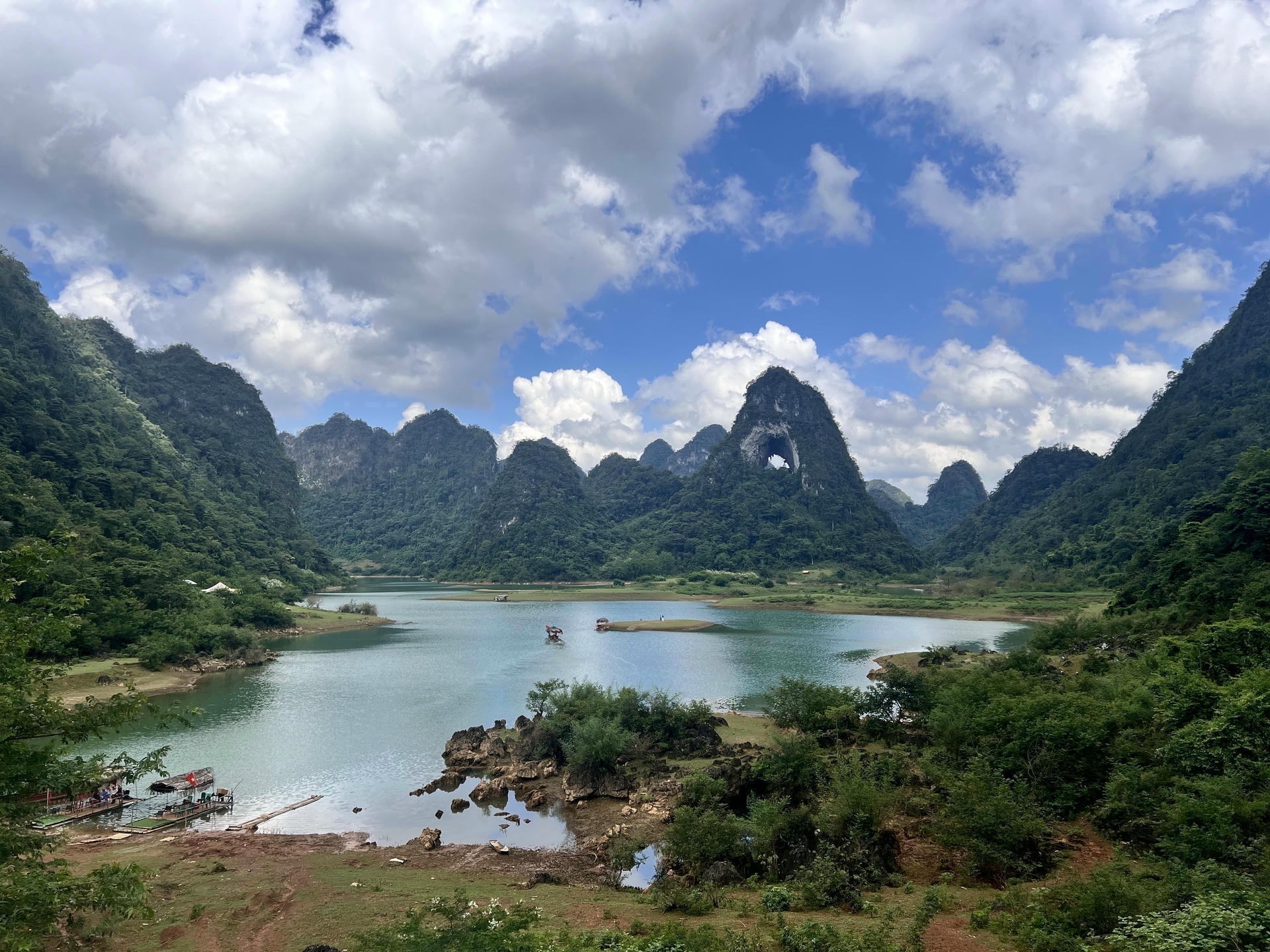
What is the Angel Eye Mountain?
Angel Eye Mountain, or Núi Mắt Thần, is one of Vietnam’s most unusual karst formations. Also called Núi Thủng or Phja Piót in the Tày language, it is known for a giant circular hole near the summit, over 50 meters wide and perfectly round like the mountain’s own eye. Formed more than 300 million years ago by underground rivers, it feels less like geology and more like a natural wonder—you won’t find another formation like it anywhere else in the country.
The mountain rises from the Thang Hen lake cluster, a landscape of 36 lakes linked by underground rivers inside the Non Nuoc Cao Bang UNESCO Global Geopark. These waters swell and retreat with the seasons, sometimes turning the valley into a vast meadow, sometimes into a mirror-like lake that reflects the arch.
How to get there
Angel Eye Mountain lies in Trùng Khánh District, about 50 kilometers northeast of Cao Bằng City, in the same province as Bản Giốc Waterfall, Ngườm Ngao Cave, and Khuổi Ky Stone Village. Most travelers reach it on the second day of the Cao Bằng Loop, and the main roads are easy enough to follow with Google Maps.
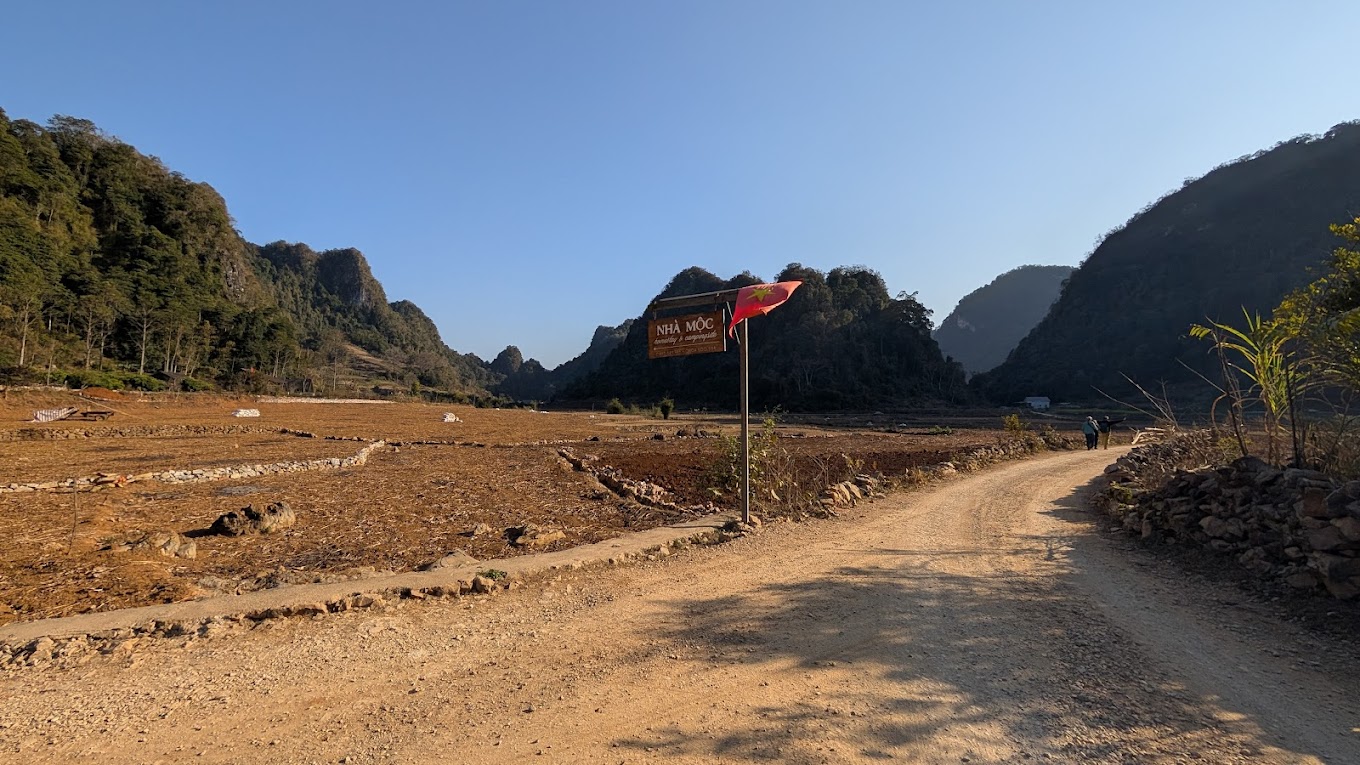
The tricky part is the last stretch. The easiest landmark to follow is Nhà Mộc Homestay. From there you ride straight toward the mountain entrance. The road is unfinished, so in the dry season it is bumpy but manageable, while in the rainy months it can turn muddy and waterlogged. The last climb is steep. If you’re confident, you can ride all the way up and park near a small drink stall; if not, leave your bike at the bottom and walk.
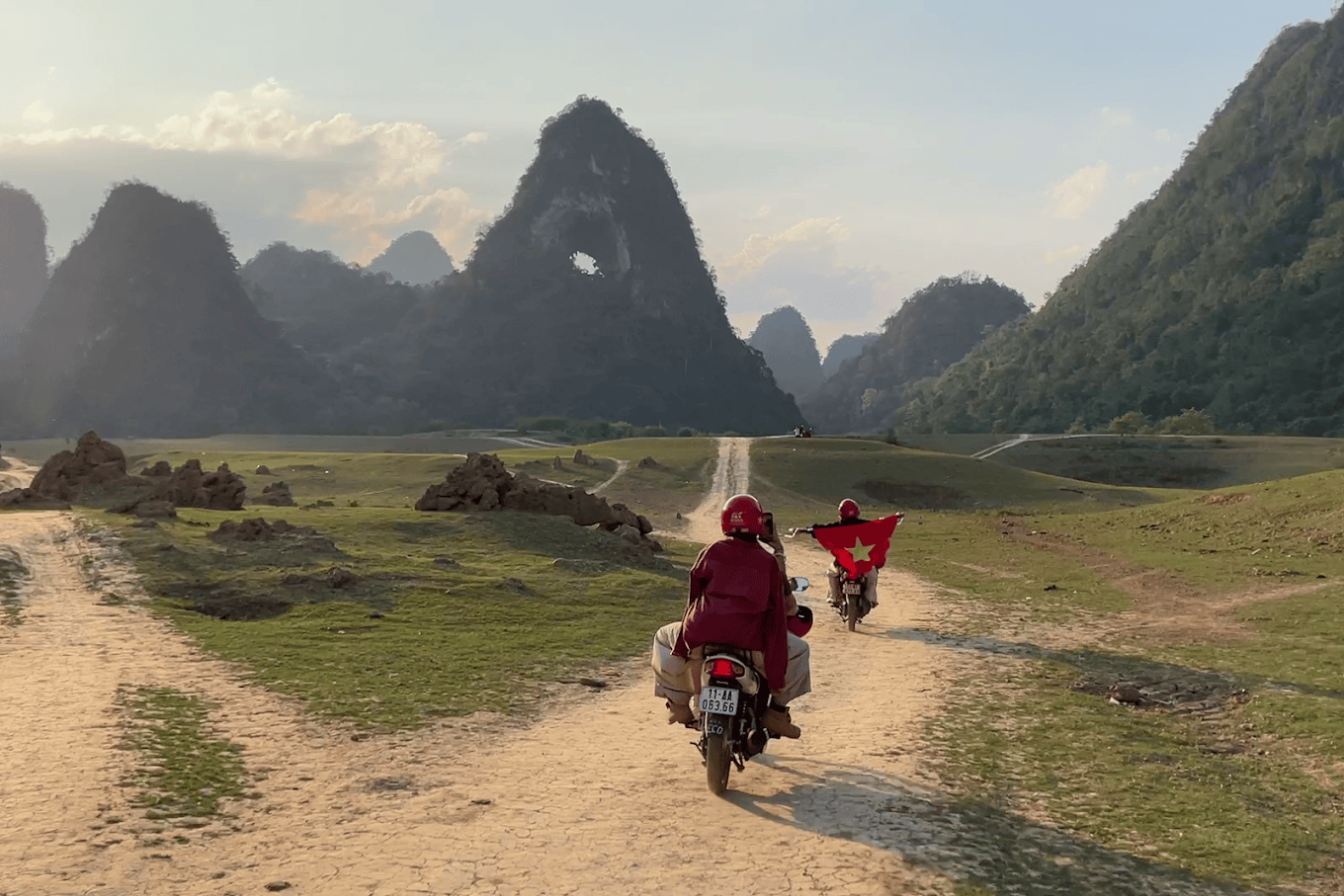
From the hilltop, a trail leads down to the campsite in about 15–20 minutes. In the dry season, some riders even take motorbikes straight into the valley, but the track is narrow, rutted, and closer to off-road terrain than a proper road, so only bikes with good clearance can handle it. Cars are not recommended.
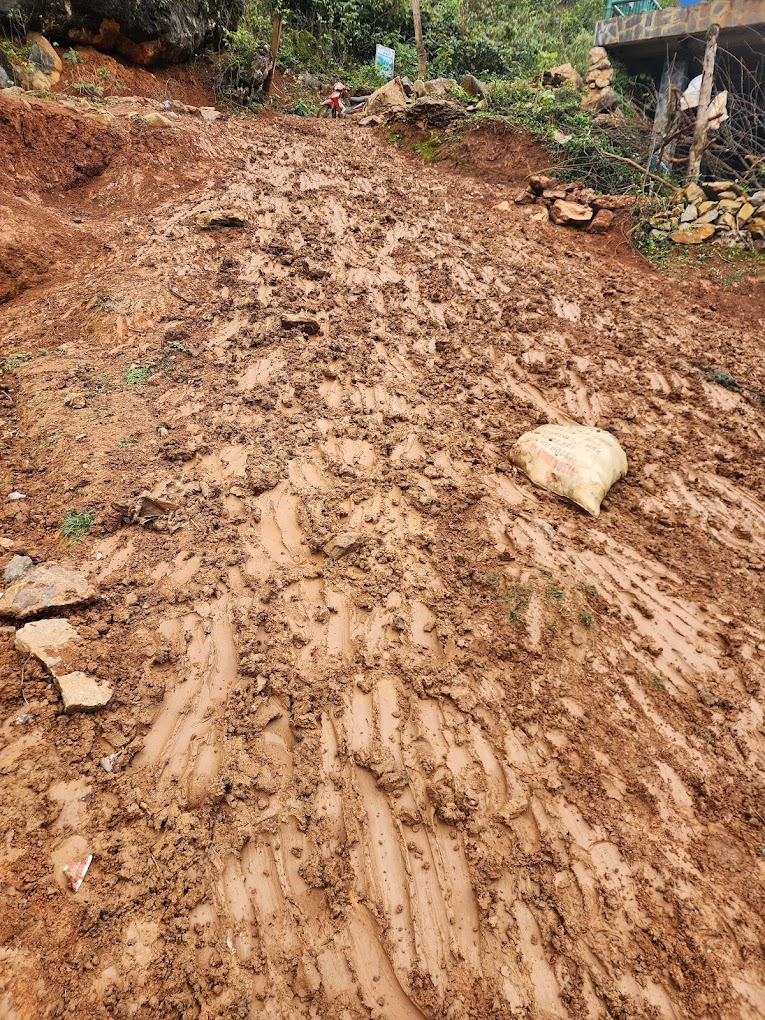
During the rainy months, it is much safer to go on foot—the path is muddy, with slick stones and steep patches that can be dangerous even for skilled riders. Good shoes are a must. If you bring too much luggage, you can leave extra bags at the drink stall and only carry what you need for the night.
Best time to visit
The valley around Angel Eye Mountain changes so much with the seasons that it feels like two different worlds.
From September to March, the water recedes and the basin turns into wide meadows. The ground is firm, nights are cool, and the sky is often clear enough for stargazing. Autumn paints the rice fields golden, while spring covers the valley in wildflowers and fresh grass. These months are the easiest for camping, with plenty of space for tents and even off-road vehicles rolling across the dry grasslands.
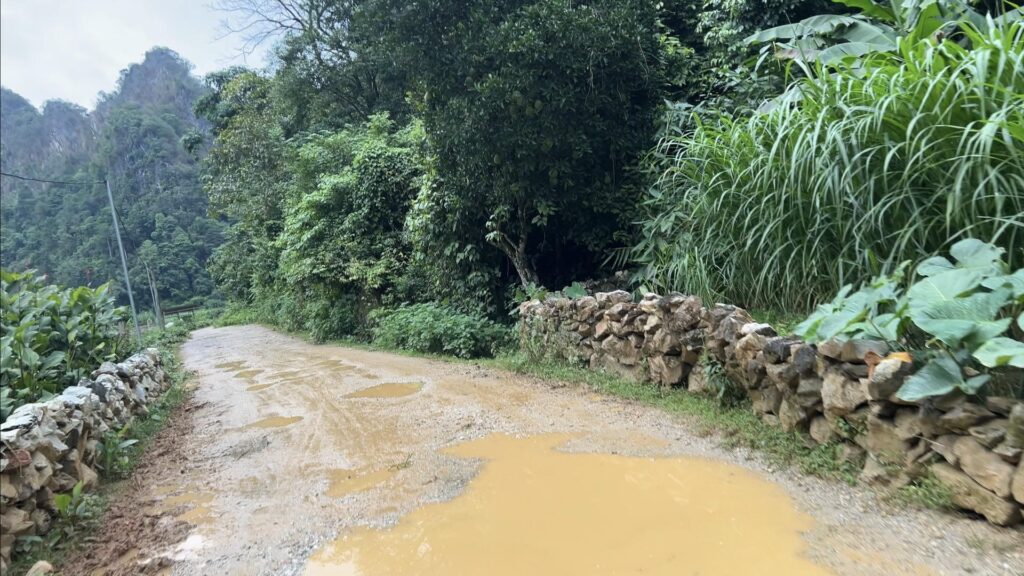
From April to August, the rains return and the valley fills with water. On calm days the mountain’s limestone arch doubles in the reflection, as if the whole valley has two skies. Locals sometimes bring out SUP boards or small boats so visitors can paddle across. Camping, however, becomes more challenging. Trails get muddy, the ground softens, and after heavy storms the basin can flood completely, leaving boats as the only way to reach the mountain.
I camped in early September, right when the season was shifting. It wasn’t the easiest time—the trails were still wet and a little slippery—but the basin held enough water for SUP paddling while the meadows were just starting to return. It felt like standing between two landscapes, half lake and half grassland. With fewer travelers around, the mountain felt quieter, almost as if it was keeping its arch just for me. Not every rainy-season trip will be that lucky though, so for a sure bet, aim for the dry months.
Camping at Angel Eye Mountain
You can either book with local operators or bring your own tent if you prefer freedom. Wild camping is possible, but it’s only practical in the dry season when the meadows are firm. In the rains, it’s safer and more comfortable to go with an organized camp.
I chose to stay with Cao Bằng Eco Camping, though two other groups—Cao Bằng Camping and Đạt Camping—also run sites here. All three have been around for a while, with similar prices and services, so whichever you book with, the experience is fairly consistent.
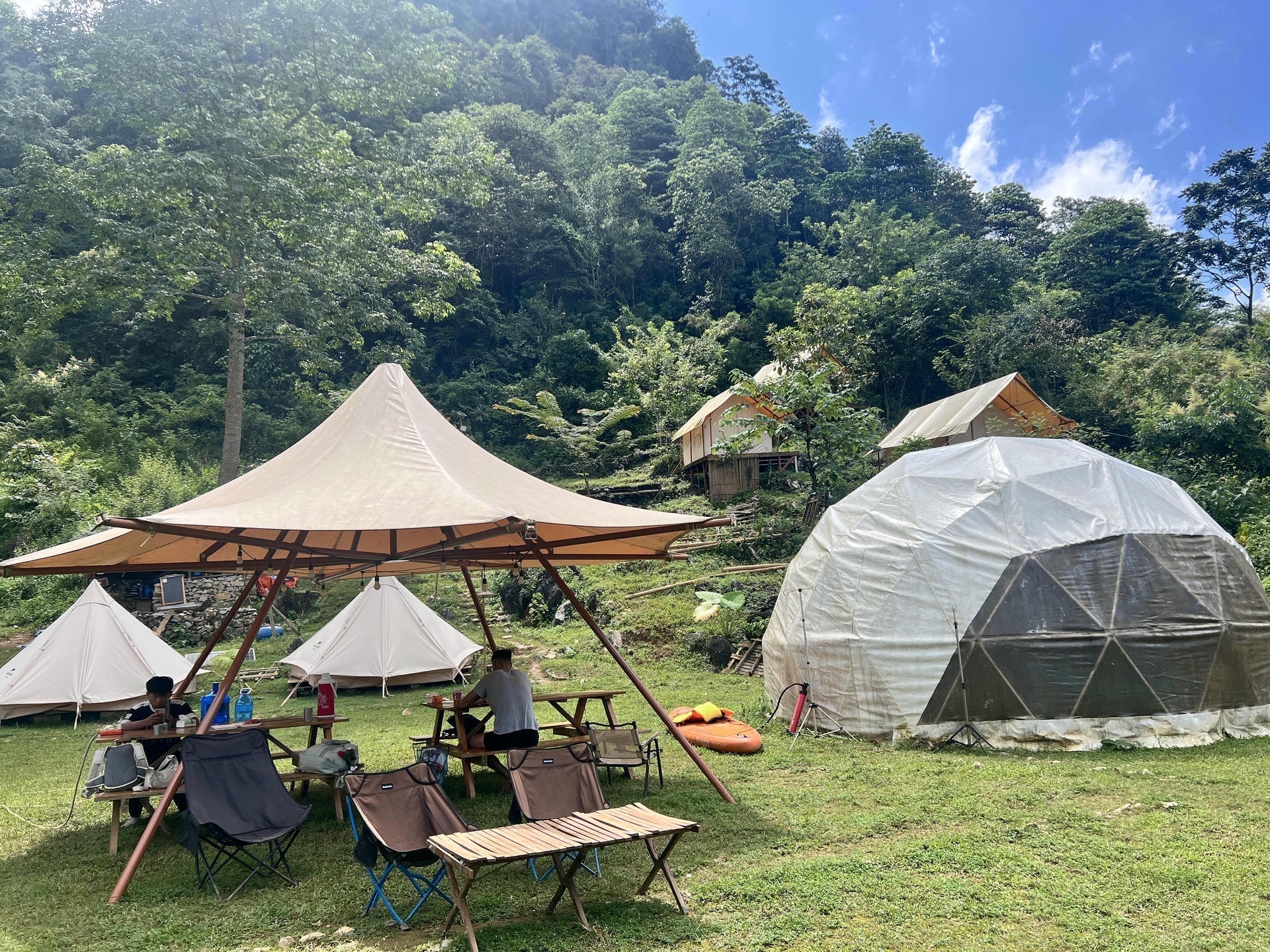
The setup is simple but convenient. Tents are ready when you arrive, so you don’t need to carry much gear. A pointed tent costs about 750,000 VND, while a house-shaped tent is around 850,000 VND, both including dinner and breakfast. Official check-in is between 4 and 9 pm, but it’s worth arriving earlier to settle in before dark.
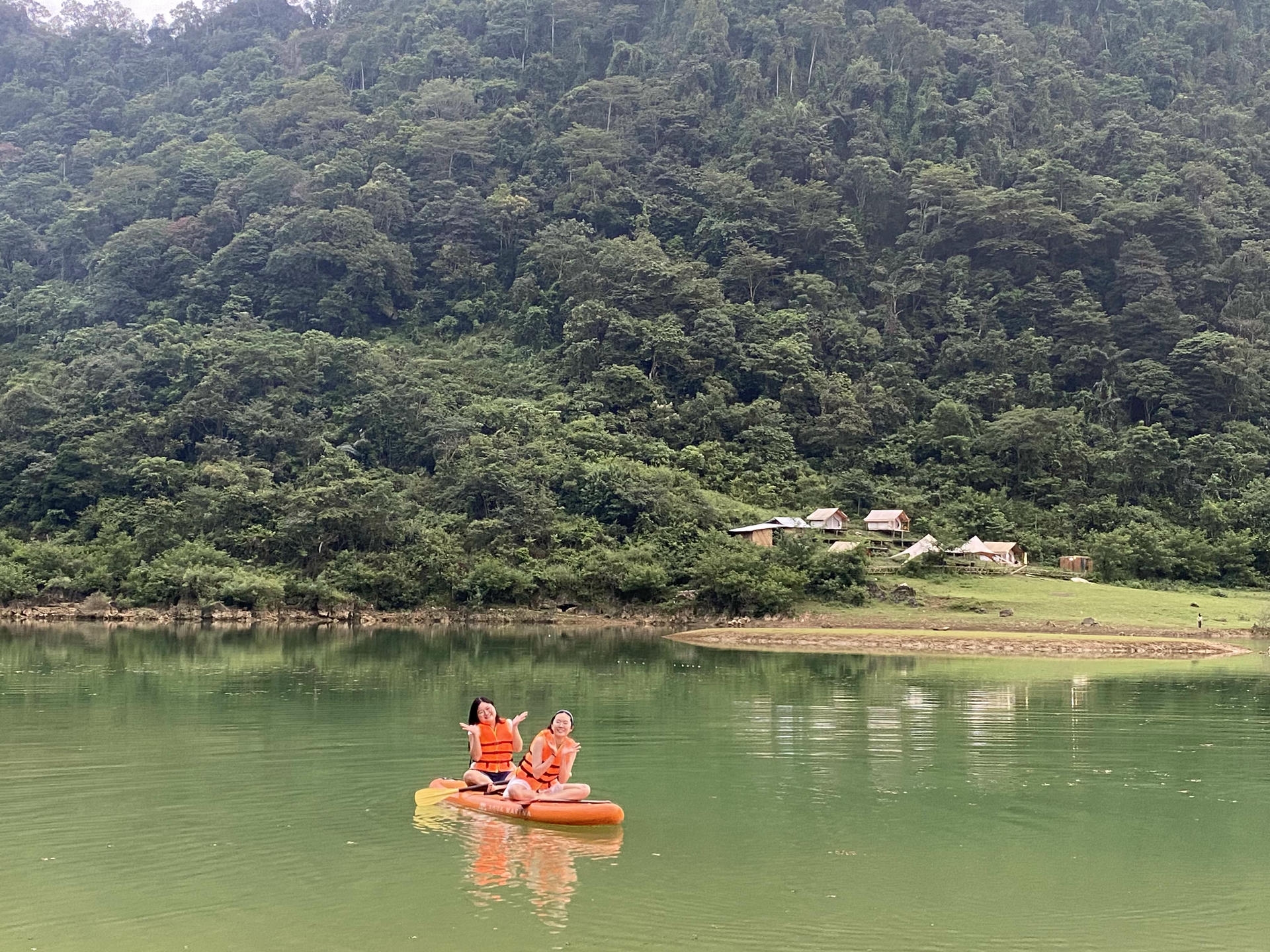
When I visited in the rainy season, the basin still held water and my host lent me a SUP board. Gliding across the flooded valley with the limestone arch towering above felt surreal. In the dry months, instead of SUP, camps often lend out off-road bikes so you can ride across the meadows.
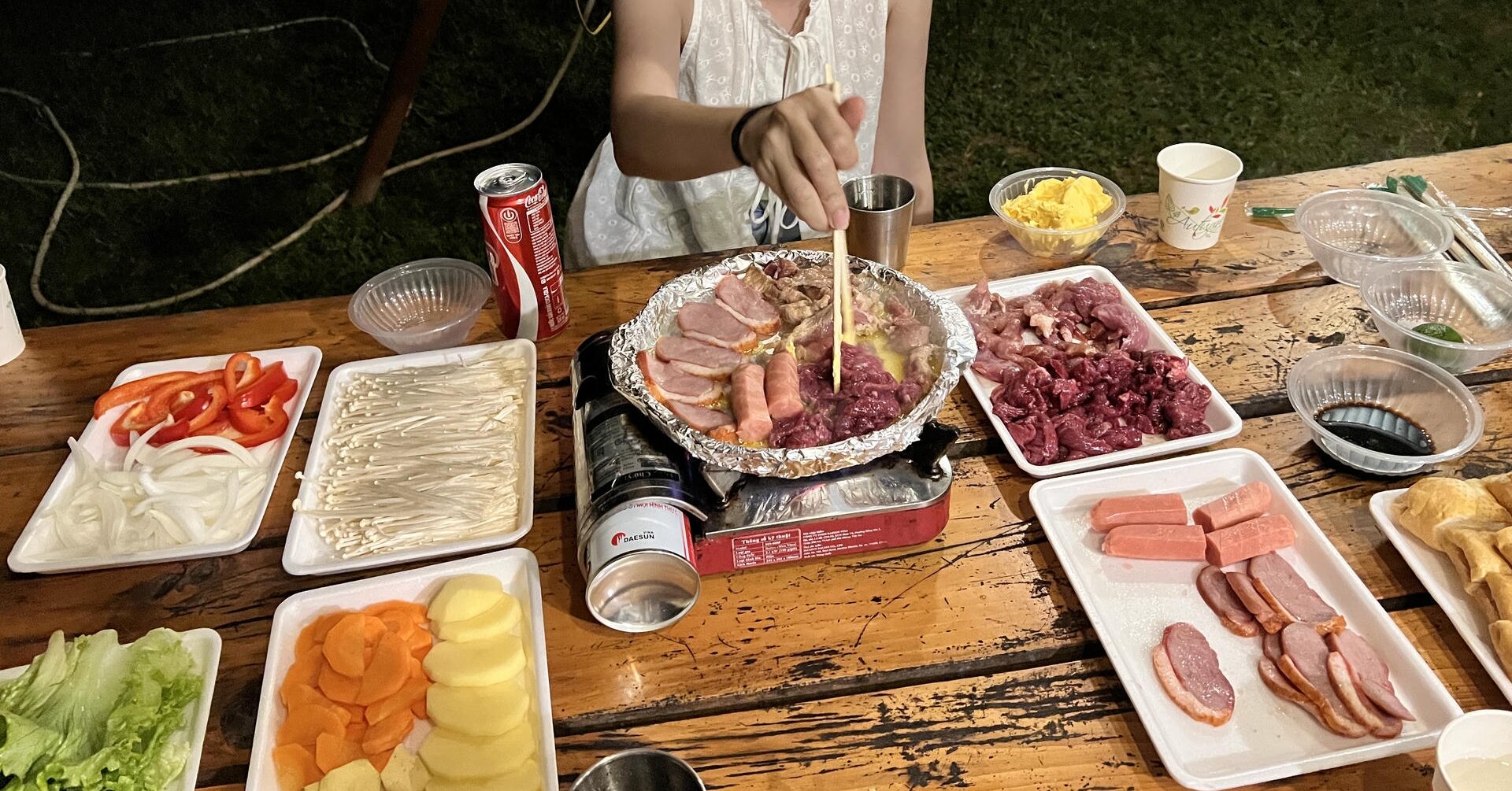
Evenings at Angel Eye Mountain follow a simple rhythm. Dinner—usually hotpot or barbecue—is served by the fire. A shared cup of corn wine, jokingly called “fake whisky,” makes its way around, warming everyone as stories begin. If the sky is clear, you might see the Milky Way stretch overhead, though even on cloudy nights, the stars alone are enough to make you look up and pause.

A few notes to keep in mind: facilities are still limited, and you may need to walk to nearby households for better toilets. Around the entrance there are also informal parking lots that sometimes overcharge, so ask your host in advance where to park. And rubbish is becoming an issue as more people camp here. If you stay, take your trash out with you so the valley remains as unspoiled as you found it.
What to pack
The campsites at Angel Eye Mountain provide the basics—tents, bedding, lights, charging points, bug spray, and meals—so you do not need to carry much. Still, a little preparation makes the night far more comfortable.
Pack these essentials:
- Warm layers, as the air cools quickly at night
- A change of clothes
- Sturdy shoes for muddy or rocky paths
- A rain jacket if visiting May–September
- Snacks or fruit in addition to provided meals
- A power bank since outlets are limited
- A swimsuit if camping in rainy months with SUP paddling
For those who plan to wild camp in the dry season, you’ll need to be more self-sufficient. Bring your own tent, cooking gear, and enough water, since there are no facilities in the meadow.
Why I’ll be back at Angel Eye Mountain
After that night, I knew camping at Angel Eye Mountain belongs on my personal list of must-dos in Cao Bang. It was the highlight of my loop, and I hope sharing this story gives you enough reason to put it on yours too.
That said, my time was in the rainy season. I still haven’t seen the valley in its full dry-season beauty, with golden rice fields stretching below the arch and starry skies wide open above. That alone is reason enough for me to come back.
And there’s one more secret I’ve been holding onto: abseiling. Yes, you can actually rappel down the “eye” itself on a guided expedition. It’s part of this tour, where you trek, paddle, camp, and finish with abseiling straight from the top of the arch. I didn’t get the chance this time, but it’s high on my list for when I return.
If you’re curious about camping here or planning your own Cao Bang Loop, feel free to reach out or leave a comment—I’m happy to share more details.


Leave a Reply